Home | Contact Us | Submit Troubleshooting Info | Search | Help
Output | Software Solutions | Proofing | Color, Screening and Calibration | Scanning | Digital Photography | Consumables | POS
Home | Contact Us | Submit Troubleshooting Info | Search | Help
Output | Software Solutions | Proofing | Color, Screening and Calibration | Scanning | Digital Photography | Consumables | POS

 |
 |
Assessment |
| 98% dots not resolved |
 |
Upper limit |
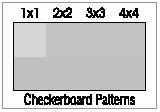 |
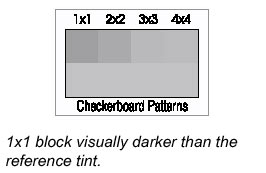
At or near target When at or near aim, the 1x1 block is visually slightly lighter than the reference tint. The 2x2 block is barely distinguishable from the reference tint. |
|
| 2% dots not resolved |
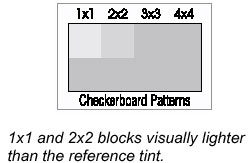 |
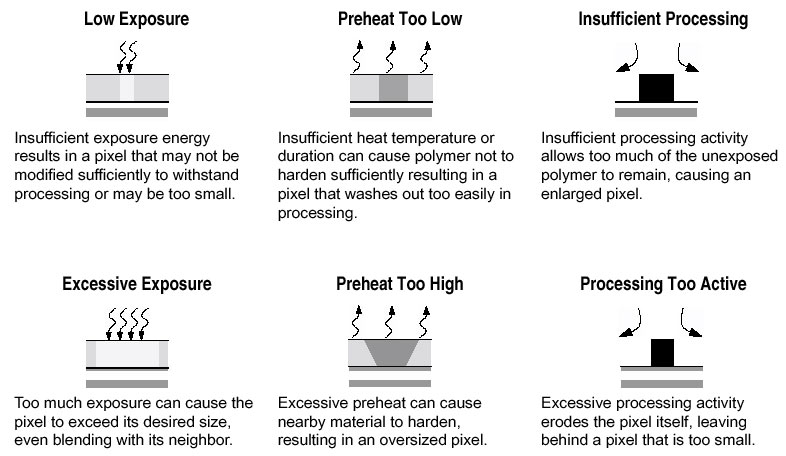
Lower limit • Pre-heat temperature too low. • Processing activity too high. This could mean any of the following: – Developer temperature too high – Too much scrub pressure in processor – Transport speed too slow |
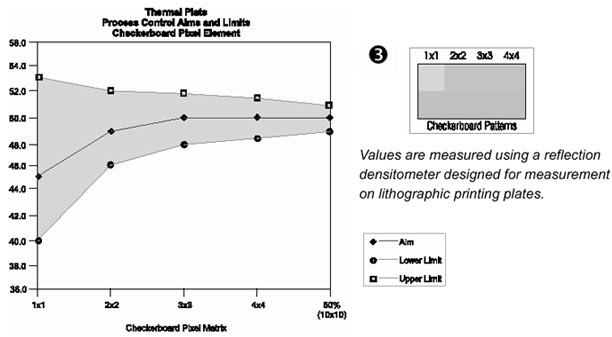
| Notes for visual checkerboard These aims and limits are intended for the Kodak Polychrome Graphics Thermal Printing Plate/830 with Creo Platesetter. Other plates may have different aims and characteristics. Contact your Kodak Polychrome Graphics Technical Representative for more details. From this chart, the 1x1 pixel gives a tint that is approximately 45% dot area. A measured tint between 40-53% indicates that the process and exposure are within acceptable tolerances. |
However, for a 2x2 pixel, there is much less
tolerance: here the aim is 49% with a range of 46-52%. As the figure shows,
this tolerance continues to decrease as the pixel dimensions increase. At
10x10 (furthest right on the chart), the tolerance for the 50% aim is only
+/- 1%. Note: Use of CCD-based instruments to measure pixel checkboard patterns is not recommended. |
||
|
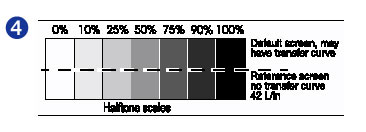
Halftone Scales
|
Use the 0% and 100% blocks for D min and D max |
||
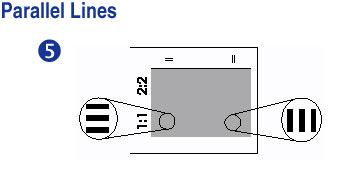 |
Lines that differ significantly or are irregular indicate possible mechanical problems either with drum rotation or with head transport. |
||
|
|||
| Laser Exposure |
• MX-1710, 9005/9008 | Pre-Heat Oven | |
| Processor Temperature |
• 25°C ± 1°C | Temperature | • 6°C (10°F) below Plate Fog Point • Typically 140°C ± 2°C |
| Transport Speed | • 0.9 meters/min | Transport Speed | • 0.9 meters/min |
| Replenishment Rate | • 15 to 20 ml/ft 2 (160 to 215 ml/m 2 ) |
Post-Bake Oven | |
| Pre-bake solution | • MX-1591 • 804 (Europe) |
Temperature | • 275°C for 90 seconds or 250°C for 3 minutes |
| Finisher for unbaked plates |
• 850S • MX-1612 mixed 1:1 with water |
Finisher for baked plates |
• 850S |
|
Other Notes and Recommendations |
|||
| Adjusting pre-heat temperature. A “quick fix” that can be used is pre-heat temperature adjustment. Note that the pre-heat temperature is carefully set (at 10 degrees below the fog point for most plate operations). On-the-spot dial |
adjustments for this temperature may compen-sate for some
problems; however, this type of quick adjustment should not be a substitute for careful analysis of trends and identification of the problem source. |
||
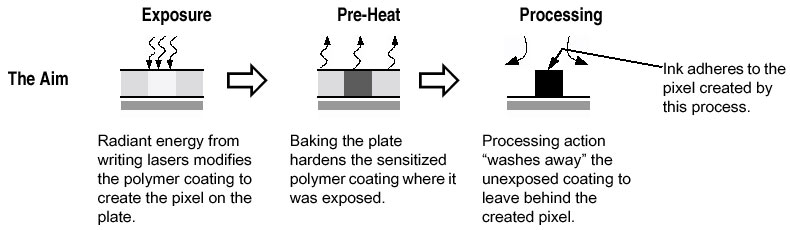
Creating a pixel in the Platemaking processing (single pixel shown in cross-section) |
|||