

Home | Contact Us | Submit Troubleshooting Info | Search | Help
Output | Software Solutions | Proofing | Color, Screening and Calibration | Scanning | Digital Photography | Consumables | POS
Home | Contact Us | Submit Troubleshooting Info | Search | Help
Output | Software Solutions | Proofing | Color, Screening and Calibration | Scanning | Digital Photography | Consumables | POS
ISDN stands for Integrated Services Digital Network. This is a digital dial-up telecommunications network that allows data and voice transfer at high speed with high reliability.
At present, speech, data images and drawings cannot be transmitted together. Each product requires its own type of network or medium, geared to the specific transmission characteristics of the product.
ISDN will carry telephone communication, faxes, electronic-mail, telex, teleconferencing, Teletex, video communications, LANs, and even audio & TV services to replace radio and aerial received television. All these media will be carried on one data line.
ISDN technologies include:
ISDN is the most commonly available fast dial-up service world wide, with uncompressed data transmission speeds of between 64 Kbps and 2 Mbps in Europe, and from 56 Kbps to 1.5 Mbps in North America.
A regular phone line can carry 28.8 Kbps of uncompressed information. ISDN is typically five times as fast, slashing telephone costs.
The main objectives of ISDN are to allow:
ISDN will allow a graceful evolution of today’s communication networks into tomorrow’s more powerful, intelligent networks. ISDN provides enhanced services at reduced cost.
The standardization of ports is desirable to network planners since it offers increased flexibility and cost savings. Universality is required for all voice and data connector ports world-wide. ISDN uses standardized interfaces, with only minor variations from continent to continent. Thus ISDN provides a real chance of attaining world-wide standardization of ports.
True portability is achieved by the adherence to a common set of standards, enabling the crossing of geographical boundaries. The universal standardization of ports made possible by ISDN, enables portability of equipment between countries.
Portability when achieved, presents equipment suppliers with a worldwide market for products that are free of local variation, achieving further economies of scale for their products.
For most network applications, the ISDN network port is flexible enough to allow users to change band-width on a dynamic basis, accommodating the different requirements that occur during a normal working day.
ISDN enables telephone operating companies to provide new services to the user.
Examples of newer services include:
The substantially faster transmission of data due to simultaneous transmission on a single line, leads to lower telephone bills. A reduction in price per service is anticipated. Reduced wiring requirements will save installation charges.
ISDN enables simultaneous transmission on a single line, leading to increased transmission rates and a reduction in in-service interval.
The better diagnostic and alternative routing capabilities inherent in the network will result in all end users getting a more reliable service.
End users will get a flexible band-width that can accommodate their changing needs on the fly, without having to reorder and wait for extra circuits. ISDN provides a dynamic allocation of channels.
Digitalization of the local loop will lead to lower bit error rates and thus to higher quality on all services.
PBX features that until now were only affordable to large businesses will become routinely available to all end users.
With the adoption of standard ISDN interfaces, it will become far easier to connect circuits across geographical boundaries.
Currently, the services provided by means of the ISDN vary from country to country, and in some countries they may even vary with the particular telephone exchange that the user is connected to.
There are regional differences in the extent of the hardware supplied by the public domain carrier network, and thus in the equipment that the customer needs to provide in order to connect up to ISDN. There are also regional differences in the services provided by different carriers. Finally, the different data carriers use different digital carrier facilities with different data transmission rates.
This section briefly summarizes the regional groupings, regional hardware variations and variations in regional data carrying capability.
The ISDN switch type appropriate for your Router depends on the ISDN provider's equipment. The following table lists the ISDN switch types:
The terminal equipment (TE) is connected to the local telecommunications exchange via two network terminations; NT1 and NT2.
Terminal equipment designed for ISDN applications (designated
as TE1 in fifth) require no terminal adapters. When older terminal equipment, designated
as TE2, is used, a terminal adapter TA is required, see figure:
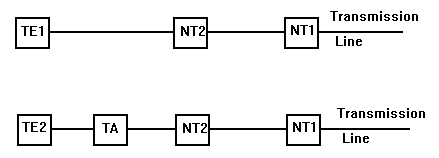
The network termination type 1 device (NT1), is a customer premises equipment in North America. In most of the rest of the world however, this is part of the network provided by the carrier (public domain equipment).
Note: In North America the Cisco Routers supplied by Scitex include NT1, but as this is supplied by network providers in the rest of the world, the Cisco Routers supplied by Scitex subsidiaries elsewhere do not.
| Terminal Point | Function | Example |
| NT1 | Line transmission termination Layer* 1 maintenance functions Timing Power transfer Layer 1 multiplexing Interface termination |
|
| NT2 | May include; Layers 2 and 3 protocol handling Layers 2 and 3 multiplexing Switching Concentration |
PBX Terminal controller Time division multiplexer |
| TE1 | Interface terminal that complies with ISDN interface requirements. | |
| TE2 | Interface terminal complying with other 'old' requirements. |
* Layer refers to the OSI model.
ISDN access channels include a Basic Rate Interface (BRI), and a Primary Rate Interface (PRI) — which comes with some regional variation.
Technical Details
The Basic Rate Interface (BRI) service offers two circuit-switched B channels and one
packet-switched D channel, it is thus designated as being "2B+D".
The BRI B-Channel service operates at 64 Kbps and is meant to carry user data. The BRI D-Channel service operates at 16 Kbs and is meant to carry control and signaling information, although it can support user data transmission under certain circumstances. In the FileTrak Over ISDN, the 2 B channels are used for data transfer and the D channel is used for digital signaling.
The D channel signaling protocol comprises layer 1 through 3 of the OSI reference model. BRI also provides for framing control and other overhead, bringing its total bit rate to 192 Kbps.
Scope of the Basic Rate Interface
The BRI interface at an individual user station allows interconnection of a single ISDN
terminal to the network. Extension or multiple installations of up to eight termination
equipment (TE) units are accommodated by the interface. Call-progress signals for both
channels are managed by the designated signaling channel, i.e. the D channel. In the Repro
ISDN Solution only one terminal equipment unit is supported by the interface; this being a
Cisco 1003/4 Router.
BRI integrates voice, data and video/image access while integrating customer premise wiring for the applications. This access also offers wider speed ranges for data communications and eliminates the need for analog modems. Because the interface is digital, all of the existing services will have better transmission quality, resulting in lower bit error rates.
Note: The FileTrak Over ISDN does not at present support PRI.
In the ISDN Primary Rate Interface (PRI) the D channel runs at 64 Kbps.
North America and Japan
The ISDN Primary Rate Interface (PRI) service in North America and Japan offers 23 B
channels and one D channel, "23B+D", yielding a total bit rate of 1.544 Mbps.
Europe, Australia and Other Parts of the World
ISDN PRI in Europe, Australia and other parts of the world, offers 30 B and one D channel,
"30B+D" and a total interface rate of 2.048 Mbps.
Scope of the Primary Rate Interface (PRI)
The PRI is a powerful interface that offers a wide range of networking features for
private networks. The D channel can carry call-signaling information that offers
network-wide features to all users. In addition, users have complete control of the
bandwidth and its allocation to different applications and between applications.
Hosts can be connected at much higher speeds, and the speed
of the access link can be selected on a call-by-call basis. All of this is being offered
digitally, thus enhancing the performance and reliability of the connections. The
following figure summarizes the difference between PRI and BRI:
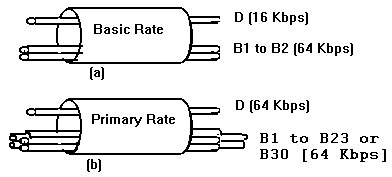
(a) Basic Rate
Interface (b) Primary Rate Interface