

Home | Contact Us | Submit Troubleshooting Info | Search | Help
Output | Software Solutions | Proofing | Color, Screening and Calibration | Scanning | Digital Photography | Consumables | POS
Home | Contact Us | Submit Troubleshooting Info | Search | Help
Output | Software Solutions | Proofing | Color, Screening and Calibration | Scanning | Digital Photography | Consumables | POS
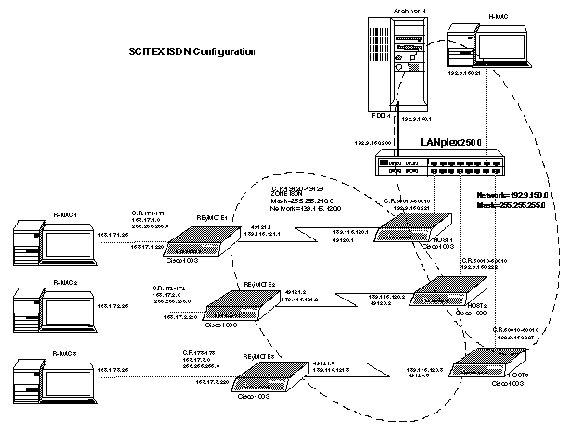 Overview
Scitex supplies the hardware to enable ISDN communication. Scitex also allocates IP addresses to her clients, organizing the ISDN network between them.
Both TCP/IP and AppleTalk protocols are supported, and the addressing system used by Scitex is designed to give a related address in both protocols.
The Scitex addressing system is detailed further on. The examples given relate to the above figure
TCP/IP is a communications protocol that allows you to communicate between workstations by assigning them with unique addresses. TCP/IP allows you to transfer files between systems, to log in to, run commands on and to print files to remote systems, and to communicate interactively or through electronic mail with remote users. TCP/IP provides basic network management capability.
How IP Addresses are Constructed
The IP address is a 32 bit code built out of four numbers each separated by a dot. This is
usually represented as A.B.C.D. Each letter refers to a number ranging between 0 and 255
with 0 being used as a gateway address and 255 being used as a broadcast address.
Usually Ethernet networks are divided into subnetworks, each subnetwork has a Subnet Mask that defines the range of addresses that the subnet can be allocated. For example, when the subnet mask is 255.255.255.0, between 1 and 254 hosts can be allocated to each subnetwork.
Throughout this document, AppleTalk refers only to AppleTalk
Phase 2.
AppleTalk addresses consist of a network number and a node number, and are written in the
format X.Y where X is the network number and Y is the node number. The net number can
range from 1 to 65534 and the node number may take on any value from 1 to 253.
Each Scitex subsidiary is allocated with two ranges of IP addresses from the total Scitex TCP/IP address range of 139.115.120.001 to 139.115.129.254.
One range; the Archiver ISDN IP Pool, should be used for addressing the host Router’s ISDN port at the Archiver site, and one range; the Client’s ISDN IP Pool should be used for addressing the satellite Router’s ISDN port at the remote site. Each subsidiary will set up a system to allocate addresses to each Router’s ISDN port.
All other IP addresses will be determined as a function of the ISDN port address. By following this methodology as detailed below, the chances of two Archivers located at different sites having the same IP address is minimized.
All examples in this Appendix are taken from the above figure.
The AppleTalk addresses used by Scitex will be calculated as functions of the respective IP addresses. This ensures that all AppleTalk addresses are unique.
When a Cisco 4500 unit is used as the Archiver site Router, all four ISDN ports are configured as one virtual interface with one IP address and one AT address. The virtual interface IP address and AT address are both used to address all four ISDN ports.
IP Address
The Archiver Site ISDN port’s IP address is taken from the Scitex subsidiary’s
Archiver ISDN IP Pool.
The address will be in the format 139.115.C.D where C is between 120 and 129 and D is between 1 and 254.
Example:
The IP address for the Cisco 1003-Host 1 ISDN Port is 139.115.120.1.
The IP address for the Cisco 1003-Host 2 ISDN Port is 139.115.120.2.
AppleTalk Address
The Archiver Site Router's ISDN port AppleTalk address X.Y, is given by the formula (49000+C).D where C is between 120 and 129 and D is between 1 and 254. Thus the Archiver Site Router's ISDN port AppleTalk address will be fixed, and will have a value between 49120.1 and 49129.254.
Example:
The AppleTalk address for the Cisco 1003-Host 1 ISDN Port is 49120.2.
The site IP subnetwork should not be changed.
The Archiver IP address A.B.C.D is constructed as follows:
Parts A.B.C are in accordance with the site IP subnetwork. Part D is equal to the D number
used to address the Archiver ISDN port. This will minimize the risk that two Archivers on
different sites installed with Scitex ISDN Routers will have the same IP address.
Example:
The IP address for the Archiver 1 is 192.9.150.1
The Archiver site AppleTalk cable range will be set to (5000+D) x 10 (where D
is the Archiver address part D - see IP Adress).
Example:
The AT cable range for the Archiver 1 is 50010 to 50010.
Where the Archiver site LAN has more than, say, 80 AppleTalk devices, and it is necessary
to allocate a larger cable range, the cable range should be set to (5000+D) x (10+n),
where n is any integer from 1 to 9.
Example:
In this case the AT cable range for the Archiver 1 would be 50010 to 50019.
Part C of the IP address; A.B.C.D of the Archiver Ethernet port on Router, should be set in accordance with the site IP subnetwork. Part D is set to 221 on HOST1, 222 on HOST2, 223 on HOST3, etc.
Example:
The IP address for the Cisco 1003-HOST 1 Ethernet Port is 192.9.150.221.
The AppleTalk address; X.Y of the Archiver site Ethernet port
on the Router will be assigned as follows:
The Cable Range; X is the same as that of the Archiver site (6.7.2) and Y is 221.
Example:
The AT address of the Cisco 1003-Host 1 Ethernet port is 50010.221
The remote ISDN port’s IP address is given by the Scitex subsidiary’s Client’s ISDN IP Pool.
The address will be in the format 139.115.C.D where C is between 120 and 129 and D is between 1 and 254.
Example:
The IP address for the Cisco 1003 Remote-1 ISDN Port is 139.115.121.1.
The remote ISDN port AppleTalk address X.Y, is given by the
formula 49000+C.D where C is between 120 and 129 and D is between 1 and 254.
Thus the Router ISDN port AppleTalk address will be fixed, and will have a value between
49120.1 and 49129.254. On the Cisco Router it is possible to fix the AppleTalk address of
a port.
Example:
The AT address for the Cisco 1003 Remote-1 ISDN Port is 49121.1.
The remote site network IP address will have the format A.B.C.D, where C is equal to the D value of the IP address of the remote Router ISDN interface.
The Scitex default values for the remote site LAN are as
follows:
A = 158
B = 17
C = the D value of the remote Router IP address
D = any value from 1 to 254
Where the customer has already configured the IP addresses of his LAN differently, and his addresses do not overlap or otherwise seem likely to cause conflict with the Scitex ISDN addressing system, and with the addresses of the Archiver site that the remote Router is connected to and is expecting to access, the customer’s configuration can be used.
Example:
The IP address for the remote site subnetwork served by the Cisco 1003 Remote 1 is
158.17.1.D.
The Remote site network AppleTalk cable range will be set to ( BC) as defined above.
Example:
The AT address for the remote site network as served by the Cisco 1003-Remote 1 is 171.D
The remote site Ethernet port IP address will have the format A.B.C.D, where C is equal to the D value of the IP address of the remote Router ISDN interface.
The Scitex default values for the remote site LAN are as
follows:
A = 158
B = 17
C = the D value of the remote Router IP address
D = 220.
Example:
The IP address for the remote site Ethernet Port as server by the Cisco 1003-Remote 1 is
158.17.1.220.
The Remote site Ethernet Port AppleTalk cable range will be set to (BC) as defined above.
Example:
The AT address for the remote site Ethernet Port as served by the Cisco 1003-Remote 1 is
171.220.